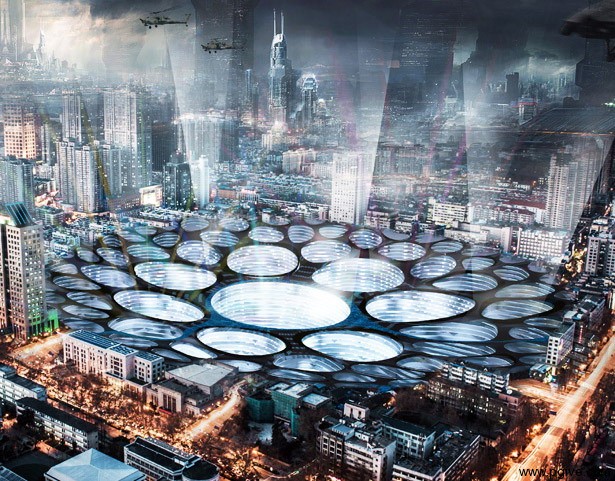
中国设计师:Xiaomiao Xiao, Lixiang Miao, Xinmin Li, Minzhao Guo Crater-Scraper在“2013年eVolo摩天大楼比赛”中获得了提名。这栋大楼是由中国几位设计师设计的,准备在一颗巨大的小行星坠毁时砸出来的弹坑中建立。整体的设计理念是要实现对立面的统一:地上与地下、人造与天然、灾难与重生,要在被小行星所摧毁的地方建立起一个乌托邦王国。建筑外铺有多孔植被所覆盖的屋顶,便于收集雨水,同时使阳光能够渗入内部。建筑内各社区围绕一个核心向外发散,有便捷的交通线相连接。该建筑遵循花园城市的设计理念,整体上是由一系列自给自足的社区所组成的,各社区周围都是绿化带,中间是一座大花园,太阳可以从每个圆柱形的入口照进来。建筑内有居民住宅、商店、办公室、医院及一些娱乐设施。大屋檐结构为道路网、植被及雨水收集系统都留下了足够的空间。雨水到达屋顶后,重新分流至弹坑边缘,创造有利于调节气温的水帘。
Crater-Scraper is a post-apocalyptic shelter that is designed to be built within a crater left behind by a massive asteroid crash. The concept as a whole, the designers say, is to unify opposites: ground and underground, artificial and natural, disaster and rebirth, to create a utopian reality in the aftermath of the disaster of an asteroid strike. The underground settlement has a porous vegetation-covered roof that collects rainwater and allows sunlight to penetrate deep within. Inside, a transportation network emanates outward from a central core, radially linking communities across the settlement.Crater-Scraper received an honorable mention in the 2013 eVolo Skyscraper Competition. Developed according to garden city principles, the Crater-Scraper’s layout comprises numerous clusters of self-contained communities surrounded with green belts, with a large park located at the core. Each cylindrical opening shines down upon housing units, shops, offices, hospitals and recreational spaces. The large roof structure provides space for a road network, vegetation and rainwater harvesting mechanisms. Rainwater is redirected from the roof towards the crater edges to create climate-regulating water curtains.
图包下载
页:
[1]