建筑师:SMP Architects
地点:费城,宾夕法尼亚州,美国
项目团队:Susan Maxman, David Ade, Scott Ritchie, Amy Owen
客户:日耳曼朋友学校
项目年份:2009
项目面积:16,400平方英尺
摄影:哈尔金摄影公司。
景观设计师:Viridian Landscape Studio
结构工程:CVM Engineers
机电工程:Vanderweil Engineers
土木工程: F.X. Browne
实验室规划设计:HE + RA
施工经理:Wolfe Scott Associates
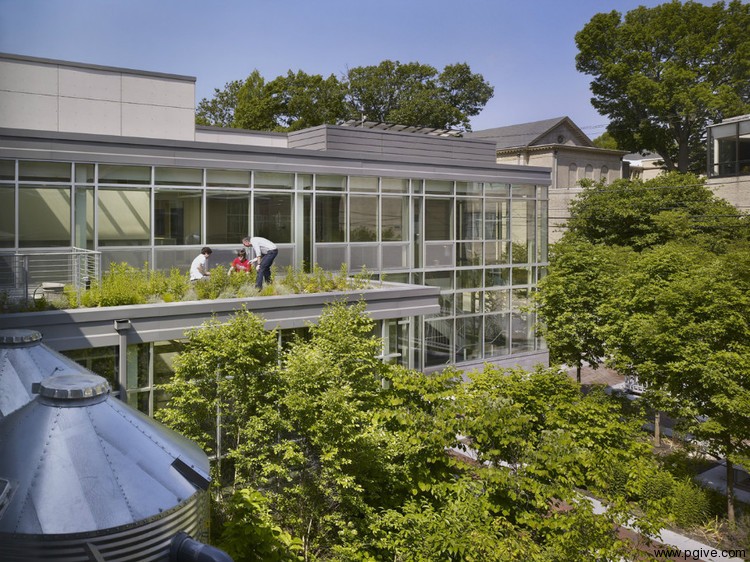
管理环境是学校的教育任务的重要组成部分,建筑和场地的设计包含了向学生展示对于自然、人文环境的责任。绿色建筑是与学校的科学教育相综合,通过展示来培养创造力,培养独立思考。绿化庭院中央形成一个活跃的户外教室,种植花样繁多的植物。雨水收集系统引导雨水的路径从屋顶落水管及其来源、铺就的庭院区,沿悬挑,到种植本地植物的园林。
带有天窗的中庭是项目核心,在楼宇监控系统显示的可持续发展的运作过程。在这里,学生和游客的可持续发展策略的性能在“实时”的对比和比较电,水,和太阳能的使用。
在建筑选址上,为了最大限度限度吸收太阳能以及室内自然采光,建筑朝南而设。屋顶的设计为集中收集雨水和采光上挑并有一定的坡度,雨水供给两个地面水池,提供建筑使用的非饮用水。
[/table]
|
原文:
Stewardship of the environment is an important part of the school’s educational mission; therefore, the building and site design embraces opportunities to demonstrate environmental responsibility. Throughout, the didactic green building is integrated with the school’s science pedagogy to create a facility that fosters independent thinking.
The landscaped central courtyard forms an active outdoor classroom surrounded by a series of planted raingardens. This raingarden system directs the path of the stormwater from its source at the roof downspouts and paved courtyard areas, along the cantilevered overhang, and through a series of nativelyplanted swales.
The skylit atrium is the heart of the project, where a building monitoring system puts sustainability on display for all to see. Here, students and visitors view the performance of the sustainability strategies in “real time” to contrast and compare electricity, water, and solar energy use.
Stormwater management was critical for the design of this urban site with best management practices used throughout. Located on a former brownfield, extensive remediation was required to address contaminants. Negotiating these conditions drove a site design that locates impervious parking to the interior of the site where stormwater was not allowed to infiltrate, while directing parking lot and roof runoff via swales into raingardens on clean portions of the site where recharge is possible.
The building is sited to maximize southern exposure into the classrooms, bridge a connection to the adjacent math department and create a shared courtyard framed by multiple raingardens. The geothermal well field is located in the driveway preserving space for future school expansion. Roof areas that are not directed to the raingardens supply two above-ground cisterns that provide the building with non-potable water for use at the water closets. Stormwater is also managed through vegetated roofs at two roof levels, the lower of which is directly accessible to students for outdoor seminars and experiments.
The six labs, two for each discipline, are paired around shared prep spaces to support collaboration among teachers and students. Biology is on the first floor with convenient access to the courtyard raingarden areas. For efficiency of systems, it shares mechanical infrastructure with Chemistry stacked directly above.
The Chemistry labs are located on the second floor to efficiently exhaust the fume hoods directly at the roof, thereby minimizing chase infrastructure and duct runs. The Physics labs, also at the second level, are cantilevered over the first floor glazed areas as a visible demonstration of the mechanics of structural design.
Bioclimatic design and energy efficiency informed the building section. A portion of the south-facing physics labs cantilever over the fullyglazed faculty offices below. Whereas regularly occupied class-room and office spaces are both heated and cooled by the geothermal system, the north-facing lobby and atrium space are only heated. A centrally located skylight/ atrium acts in conjunction with low operable windows to naturally ventilate the space, drawing cool air across the exposed concrete floors and through the skylight louvers.
The single-loaded circulation spaces are flooded with daylight and are organized around the naturally landscaped courtyard to visibly and physically connect students to the outdoors at all times. Tucked within the circulation spaces, study areas and conversation nooks are designed for informal discussions between students and teachers.
In the lab classrooms, where a replaceable floor surface is needed in case of chemical spills, rubber tiles provide a green alternative to traditional vinyl flooring. At the Chemistry classrooms, the rubber floor tile is laser cut into the Periodic Table of Elements as integrated educational tool.
Studio type layouts provide for lecture and lab areas within the same classroom while maximizing flexibility for the user. The shared prep areas between the Biology classrooms include interior borrowed light glazing for direct sightlines between spaces, as well as for student views to the laboratory equipment contained within.
Throughout the classroom interiors, large expanses of glazing provide for generous daylighting and visual connections to the surrounding campus and neighborhood. The exposed structural steel is a candid expression of the building construction, and in the Physics classrooms, it serves the dual purpose of providing for gravity and other types of mechanical experiments.
The design clearly articulates the facility’s program through its organization of classroom “building blocks” for Biology, Chemistry, and Physics with transparent glazing for the circulation spaces, meeting rooms and shared office areas.
图包下载
页:
[1]