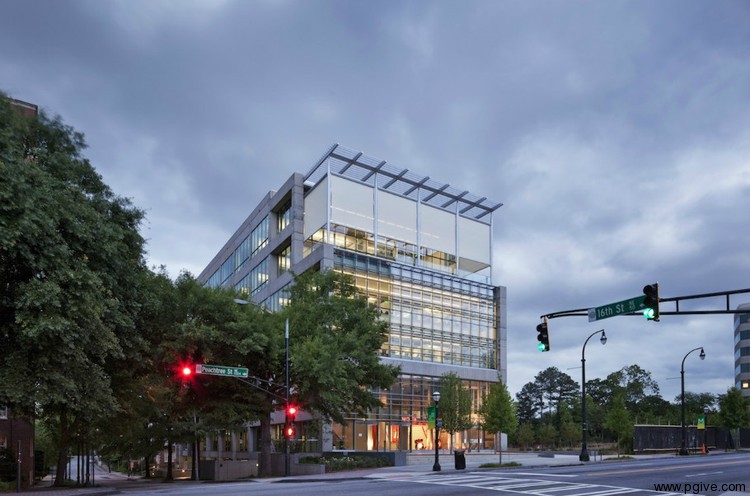
理解环境责任是卓越的设计的一个组成部分,帕金斯+威尔的大西洋新办公室,称为1315Peachtree,作为一个例子,在目前的技术如何可以用来达到LEED白金认证,满足2030的挑战和有助于减少我们的建筑产品的有毒物质。
1600平方英尺的设施,揭示了混凝土结构和分流的家具80%,从垃圾填埋场的结束和拆卸碎片。帕金斯+威尔也能够适合当地需求的再利用的材料,使其获得超过20家的非营利组织捐款。在建筑整体环境布局上,为了提高街景和加强城市环境,帕金斯+威尔提出了一个新的市民广场和新的景观在一楼。用于传统医药应用的植物,如金缕梅,薰衣草和厚朴种植在市民广场,反映帕金斯+威尔的卫生保健公司的实践领域。反映帕金斯+威尔的医疗保健和健康的业务领域,该公司使用的植物。未经压缩在广场树井提供更多的氧气,在土壤中建立一个健康的树的根系统中高度有机的,修复土壤已经离开,。此外,已扩大到现有的树井周围的树木让更多的表面面积,增加水的供应,同时减少径流。
为了解决该地区的水问题,已经取代了透水材料hardscaping和雨水收获和存储了10000加仑的水箱内,然后过滤和处理现场和使用他们的厕所冲洗装置和景观灌溉的100%。溢出水过滤前自然被允许充电的含水层下的广场。
从油漆到墙上的图形,地毯,家具,材料和产品进行了筛选,以减少VOC,PVC等有毒物质对我们的预防列表。使用这些材料,以及通过增加通风地板下的空气分配有助于保持一个清洁,健康的室内空气质量。
5楼中庭进行了重新设计一个高性能的幕墙和采光系统,以防止从西部的太阳能热增益和眩光。这种变化也让帕金斯+威尔重塑结构的影响最小,并提供在办公室的地板之间的连接,以及添加一个户外露台,创造了各种支持的创造性和合作的气氛,为全办事处的会议和活动的空间。钢网格和电动遮阳系统免受太阳光穿透的空间。这一点很重要,因为该公司举办一个星期五的“啤酒时间”,不得中断。
自然采光和实用的户外空间,降低了照明所需的能源量为67%。
无线笔记本电脑每工作和组合,团队间客房,公共区域和休息室,室内和室外,让员工舒适地工作每一天。
超过60%的结构是完全可拆卸的设计是解构和重新利用。
通过使用水,而不是空气来加热和冷却的空间来实现显著的能源效率。在金属天花吊顶板内部,冷热水被泵入毛细管换热器。新鲜空气通过高架地板系统,引入地板,除了在我们的核心。通过更换小泵和管道的大型风机和管道系统,空间和能源都将被保存。
结合的采光战略,人体感应器,高效设备,辐射采暖/制冷,地板下的空气分配和屋顶能量回收轮的低速项目的能源使用量降低约58%。现场测量和监控系统,相信这是所有正常工作。
一种热回收单元,也称为焓轮,从一个空气流进行热交换和湿度的另一个在屋顶上。而不是丢弃!建筑空气的焓轮将有用的能量转换为电能,新鲜的空气。这样可以节省能源,减少在冬天在夏天制冷和加热的需要。
两个微型涡轮机,紧凑型涡轮发电机,产生电能。虽然可以选用多种燃料,但帕金斯使用天然气作为清洁的燃料。同时,吸附式制冷机使用市政水作为制冷剂,且将硅胶用作干燥剂,而不是氟氯化碳或氟利昂,溴化锂,或氨。将有害物质泄漏消除,以减少腐蚀,化学污染以及减少对大气中的臭氧损害。
原文:
Understanding that environmental responsibility is an integral part of design excellence, Perkins + Will’s new Atlantic office, known as 1315 Peachtree, serves as an example on how current technologies can be used to achieve LEED Platinum Certification, meet the 2030 Challenge and help reduce toxic materials from our building products.
1315 Peachtree is an adaptive reuse of a 1985 office structure transformed into a high performance civic-focused building. Located in the heart of Midtown Atlanta across from the High Museum of Art, the new building continues to house the Peachtree Branch of the Atlanta-Fulton County Public Library and introduces a new street-level tenant space occupied by the Museum of Design Atlanta (MODA). The Perkins+Will Atlanta office occupies the top four floors with office space for up to 240 employees. Continue reading for more information on the highest LEED score building in the Northern Hemisphere.
“As Mayor of the city, I am proud that Atlanta is home to the highest LEED score of any building in the Northern Hemisphere at this time. Perkins+Will’s LEED Platinum office building shows what happens when true innovation in design, sustainability and reuse come together. This designation further underscores Atlanta’s commitment to becoming a top 10 sustainable city in the United States. I applaud Perkins+Will on their achievement.” Kasim Reed – Mayor, City of Atlanta
The Midtown Atlanta location was chosen for its reuse challenge, understanding that reusing and retrofitting an existing building with an average level of energy performance almost always offers environmental savings over demolition and more energy-efficient new construction (see The Greenest Building: Quantifying the Environmental Value of Building Reuse). Additionally, the new office is easily accessible from in-town neighborhoods, the Arts Center Transit Station and has access to shopping, dining and cultural venues. This allows 30% of their employees commute by walking, bicycling or using mass transit and carpooling.
The 1600 square-foot facility was deconstructed, revealing the concrete structure and diverting over 80% of the furnishing, finishes and demolition debris from landfills. Perkins + Will was also able to match materials for reuse with local needs, resulting in donations to over 20 non-profit organizations.
1315 Peachtree opened in 2011 with full occupancy while Midtown suffered a vacancy rate over 20%. In order to improve the streetscape and reinforce the urban environment, Perkins + Will introduced a new civic plaza and renewed the landscape on the ground floor.
Plants used in traditional medicinal applications, such as Witch Hazel, Lavender and Magnolia Bark, where planted in the civic plaza, reflecting Perkins + Will’s health care and wellness practice areas of the firm. Highly organic, remediated soil has been left uncompacted in the plaza tree wells providing additional oxygen in the soil establishing a healthy root system for the tree. In addition, existing tree wells have been expanded to allow more surface area around the trees to increase water supply while reducing runoff.
To address the region’s water issues, pervious materials have replaced hardscaping and rainwater is harvested and stored within a 10,000 gallon cistern, which it is then filtered and treated onsite and used for 100% of their restroom flush fixtures and landscape irrigation. Overflow water is channeled under the plaza where it is filtered before naturally being allowed to recharge our aquifers.
From paints to wall graphics to carpet to furniture, materials and products were screened to reduce VOC’s, PVC, and other toxic substances found on our Precautionary List. Use of these materials as well as increased ventilation through under-floor air distribution helps to maintain a clean, healthy indoor air quality.
The 5th floor atrium was redesigned with a high-performance curtain wall and glazing system in order to prevent solar heat gain and glare from the west. This change also allowed Perkins + Will to reshape the structure with minimal impact and provide connections between the floors of the office as well as add an exterior terrace, creating a variety of spaces to support a creative and collaborative atmosphere for office-wide meetings and events. A steel trellis and motorized shade system protects from too much sun penetrating the space. This is important, as the firm hosts a Friday “Beer Time” that mustn’t be interrupted.
Natural daylight and usable outdoor space reduced the amount of energy needed for lighting by 67%.
Wireless laptops for each working and a mix of individual benching stations, team rooms, common areas and lounges, both indoor and outdoor, allows workers to comfortably move around throughout the day.
Over 60% of the structure is entirely demountable and designed to be deconstructed and repurposed.
Significant energy efficiency is achieved by using water rather than air to heat and cool the space. Cold and hot water is pumped through small capillary mats in the metal ceilings panels throughout. Fresh air ventilation comes from the raised floor system that covers the floor except at our core. By replacing large fans and ductwork with small pumps and piping, both space and energy are saved.
Combining strategies of daylighting, occupancy sensors, highly efficient equipment, radiant heating/cooling, low velocity under floor air-distribution and a rooftop energy-recovery wheel reduces the project’s energy usage by approximately 58%. A live metering and monitoring system makes sure it’s all properly working together.
A heat recovery unit, also referred to as an enthalpy wheel, exchanges heat and humidity from one air-stream to another on the rooftop. Rather than discard used building air, an enthalpy wheel salvages useful energy and transfers it to incoming, fresh air. This saves energy by reducing the need for cooling in the summer and heating in the winter.
Two MicroTurbines, which are compact turbine generators, produce electricity onsite. Although they can run on a variety of fuels, Perkins + Will uses natural gas as a clean fuel source. Meanwhile, an adsorption chiller uses municipal water as the refrigerant and silica gel as the desiccant, rather than CFCs or Freon, lithium bromide, or ammonia. Eliminating these substances eliminates the potential for hazardous material leaks, aggressive corrosion, chemical testing, and damage to upper-level atmospheric ozone.
This project has received multiple awards and praise from the community.
“Perkins+Will has designed a showpiece building.1315 Peachtree Street exemplifies the kind of environmentally sustainable measures that can be taken during a building retrofit. It has earned its high LEED score and will continue to pay dividends through energy saving measures for decades to come.” Rick Fedrizzi – President, CEO and Founding Chair of the U.S. Green Building Council (USGBC)
Architect: Perkins+Will
Perkins+Will Integrated Design Team:
Urban Design(城市设计): David Green, AIA, LEED? AP, John Threadgill, ASLA
Landscape Architecture(景观设计): Alexander Stewart, ASLA, LEED? AP
Planning & Strategies(规划及策略): Janice Barnes, PhD, LEED? AP BD+C
Sustainable Design(可持续设计):: Paula Vaughan, AIA, LEED? Faculty
Architecture(架构):: Bruce McEvoy, AIA, LEED? AP, Don Reynolds, AIA, LEED? AP, Matt Finn, LEED AP
Interior Design(室内设计): David Sheehan, IIDA, LEED? AP and Kim Chamness, AIA, LEED? AP
Branded Environments(品牌环境): Brian Weatherford, ISP, LEED? AP and Keith Curtis
Geotechnical(岩土工程): ATC Associates Inc.
Civil Engineer(土木工程师): Kimley-Horn and Associates, Inc.
Structural Engineer(结构工程师): Uzun & Case Engineers
Mechanical, Electric, Plumbing Engineer(机械,电气,水暖工程师): Integral Group
Building Commissioning(大厦调试): BVM Engineering, Inc.
DEBT / EQUITY: Harris Bank, Wells Fargo
General Contractor: Brasfield & Gorrie, LLC
Counsel: Spell, Pless, Auro PC
Tenant Representation: The Meddin Company
物业管理:高力国际管理 - 亚特兰大
公众参与:中城联盟,亚特兰大富尔顿公共图书馆系统,亚特兰大发展局
Understanding that environmental responsibility is an integral part of design excellence, Perkins + Will’s new Atlantic office, known as 1315 Peachtree, serves as an example on how current technologies can be used to achieve LEED Platinum Certification, meet the 2030 Challenge and help reduce toxic materials from our building products.
1315 Peachtree is an adaptive reuse of a 1985 office structure transformed into a high performance civic-focused building. Located in the heart of Midtown Atlanta across from the High Museum of Art, the new building continues to house the Peachtree Branch of the Atlanta-Fulton County Public Library and introduces a new street-level tenant space occupied by the Museum of Design Atlanta (MODA). The Perkins+Will Atlanta office occupies the top four floors with office space for up to 240 employees. Continue reading for more information on the highest LEED score building in the Northern Hemisphere.
“As Mayor of the city, I am proud that Atlanta is home to the highest LEED score of any building in the Northern Hemisphere at this time. Perkins+Will’s LEED Platinum office building shows what happens when true innovation in design, sustainability and reuse come together. This designation further underscores Atlanta’s commitment to becoming a top 10 sustainable city in the United States. I applaud Perkins+Will on their achievement.” Kasim Reed – Mayor, City of Atlanta
The Midtown Atlanta location was chosen for its reuse challenge, understanding that reusing and retrofitting an existing building with an average level of energy performance almost always offers environmental savings over demolition and more energy-efficient new construction (see The Greenest Building: Quantifying the Environmental Value of Building Reuse). Additionally, the new office is easily accessible from in-town neighborhoods, the Arts Center Transit Station and has access to shopping, dining and cultural venues. This allows 30% of their employees commute by walking, bicycling or using mass transit and carpooling.
The 1600 square-foot facility was deconstructed, revealing the concrete structure and diverting over 80% of the furnishing, finishes and demolition debris from landfills. Perkins + Will was also able to match materials for reuse with local needs, resulting in donations to over 20 non-profit organizations.
1315 Peachtree opened in 2011 with full occupancy while Midtown suffered a vacancy rate over 20%. In order to improve the streetscape and reinforce the urban environment, Perkins + Will introduced a new civic plaza and renewed the landscape on the ground floor.
Plants used in traditional medicinal applications, such as Witch Hazel, Lavender and Magnolia Bark, where planted in the civic plaza, reflecting Perkins + Will’s health care and wellness practice areas of the firm. Highly organic, remediated soil has been left uncompacted in the plaza tree wells providing additional oxygen in the soil establishing a healthy root system for the tree. In addition, existing tree wells have been expanded to allow more surface area around the trees to increase water supply while reducing runoff.
To address the region’s water issues, pervious materials have replaced hardscaping and rainwater is harvested and stored within a 10,000 gallon cistern, which it is then filtered and treated onsite and used for 100% of their restroom flush fixtures and landscape irrigation. Overflow water is channeled under the plaza where it is filtered before naturally being allowed to recharge our aquifers.
From paints to wall graphics to carpet to furniture, materials and products were screened to reduce VOC’s, PVC, and other toxic substances found on our Precautionary List. Use of these materials as well as increased ventilation through under-floor air distribution helps to maintain a clean, healthy indoor air quality.
The 5th floor atrium was redesigned with a high-performance curtain wall and glazing system in order to prevent solar heat gain and glare from the west. This change also allowed Perkins + Will to reshape the structure with minimal impact and provide connections between the floors of the office as well as add an exterior terrace, creating a variety of spaces to support a creative and collaborative atmosphere for office-wide meetings and events. A steel trellis and motorized shade system protects from too much sun penetrating the space. This is important, as the firm hosts a Friday “Beer Time” that mustn’t be interrupted.
Natural daylight and usable outdoor space reduced the amount of energy needed for lighting by 67%.
Wireless laptops for each working and a mix of individual benching stations, team rooms, common areas and lounges, both indoor and outdoor, allows workers to comfortably move around throughout the day.
Over 60% of the structure is entirely demountable and designed to be deconstructed and repurposed.
Significant energy efficiency is achieved by using water rather than air to heat and cool the space. Cold and hot water is pumped through small capillary mats in the metal ceilings panels throughout. Fresh air ventilation comes from the raised floor system that covers the floor except at our core. By replacing large fans and ductwork with small pumps and piping, both space and energy are saved.
Combining strategies of daylighting, occupancy sensors, highly efficient equipment, radiant heating/cooling, low velocity under floor air-distribution and a rooftop energy-recovery wheel reduces the project’s energy usage by approximately 58%. A live metering and monitoring system makes sure it’s all properly working together.
A heat recovery unit, also referred to as an enthalpy wheel, exchanges heat and humidity from one air-stream to another on the rooftop. Rather than discard used building air, an enthalpy wheel salvages useful energy and transfers it to incoming, fresh air. This saves energy by reducing the need for cooling in the summer and heating in the winter.
Two MicroTurbines, which are compact turbine generators, produce electricity onsite. Although they can run on a variety of fuels, Perkins + Will uses natural gas as a clean fuel source. Meanwhile, an adsorption chiller uses municipal water as the refrigerant and silica gel as the desiccant, rather than CFCs or Freon, lithium bromide, or ammonia. Eliminating these substances eliminates the potential for hazardous material leaks, aggressive corrosion, chemical testing, and damage to upper-level atmospheric ozone.
This project has received multiple awards and praise from the community.
“Perkins+Will has designed a showpiece building.1315 Peachtree Street exemplifies the kind of environmentally sustainable measures that can be taken during a building retrofit. It has earned its high LEED score and will continue to pay dividends through energy saving measures for decades to come.” Rick Fedrizzi – President, CEO and Founding Chair of the U.S. Green Building Council (USGBC)
Architect: Perkins+Will
Perkins+Will Integrated Design Team:
Urban Design(城市设计): David Green, AIA, LEED? AP, John Threadgill, ASLA
Landscape Architecture(景观设计): Alexander Stewart, ASLA, LEED? AP
Planning & Strategies(规划及策略): Janice Barnes, PhD, LEED? AP BD+C
Sustainable Design(可持续设计):: Paula Vaughan, AIA, LEED? Faculty
Architecture(架构):: Bruce McEvoy, AIA, LEED? AP, Don Reynolds, AIA, LEED? AP, Matt Finn, LEED AP
Interior Design(室内设计): David Sheehan, IIDA, LEED? AP and Kim Chamness, AIA, LEED? AP
Branded Environments(品牌环境): Brian Weatherford, ISP, LEED? AP and Keith Curtis
Geotechnical(岩土工程): ATC Associates Inc.
Civil Engineer(土木工程师): Kimley-Horn and Associates, Inc.
Structural Engineer(结构工程师): Uzun & Case Engineers
Mechanical, Electric, Plumbing Engineer(机械,电气,水暖工程师): Integral Group
Building Commissioning(大厦调试): BVM Engineering, Inc.
DEBT / EQUITY: Harris Bank, Wells Fargo
General Contractor: Brasfield & Gorrie, LLC
Counsel: Spell, Pless, Auro PC
Tenant Representation: The Meddin Company
物业管理:高力国际管理 - 亚特兰大
公众参与:中城联盟,亚特兰大富尔顿公共图书馆系统,亚特兰大发展局
建人乱评:
这一篇日志算是对浙江长兴布鲁克被动式公寓《Bruck》一文缺失部分的解释,为美国LEED建筑的判定标准!可持续建筑的设计并非与一般建筑设计,它们有着本质性的区别,我们缺少德国人的严谨,美国人的跳跃性思维,而更多的采用“经验”,延续思维惰性,缺乏集体性讨论,而是以“管理者”的态度去做项目,70、50、30年的建筑持有期,导致我们的设计经验化、施工短视化,不可持续化,我们的《标准》毫无底线,这是我们整个民族建筑史的悲哀!
图包下载
页:
[1]