Architects: GLUCK+
Location: New York, USA
Project Team: Guido Furlanello,
Peter L. Gluck, Thomas Gluck, Jason Kreuzer, Scott Scales, Jeff
Straesser
Structural Engineer: Robert Silman Associates P.C.
Mep Engineer:
Rodkin Cardinale Consulting Engineers P.C.
Year: 2009
Photographs: Raimund
Koch, Erik Freeland
该项目为改造的城市联排别墅,曼哈顿典型的狭窄空间。从根本上重新配置的组织和建筑立面,阁楼式生活空间,客户喜欢充足光线的室内设计同时保持相对的隐私。
被重新定义传统的平面图和剖面向上推临街门面,而不是客厅的墙壁沿着楼梯和电梯设置。阁楼式的空间运行流畅的整个长度在38英尺深的建筑,而不是被划分成小的前面和后面的房间。开放的夹层客厅,私人办公室的角落,私人卧室和起居室,像丝带一般缠绕在楼梯四周。
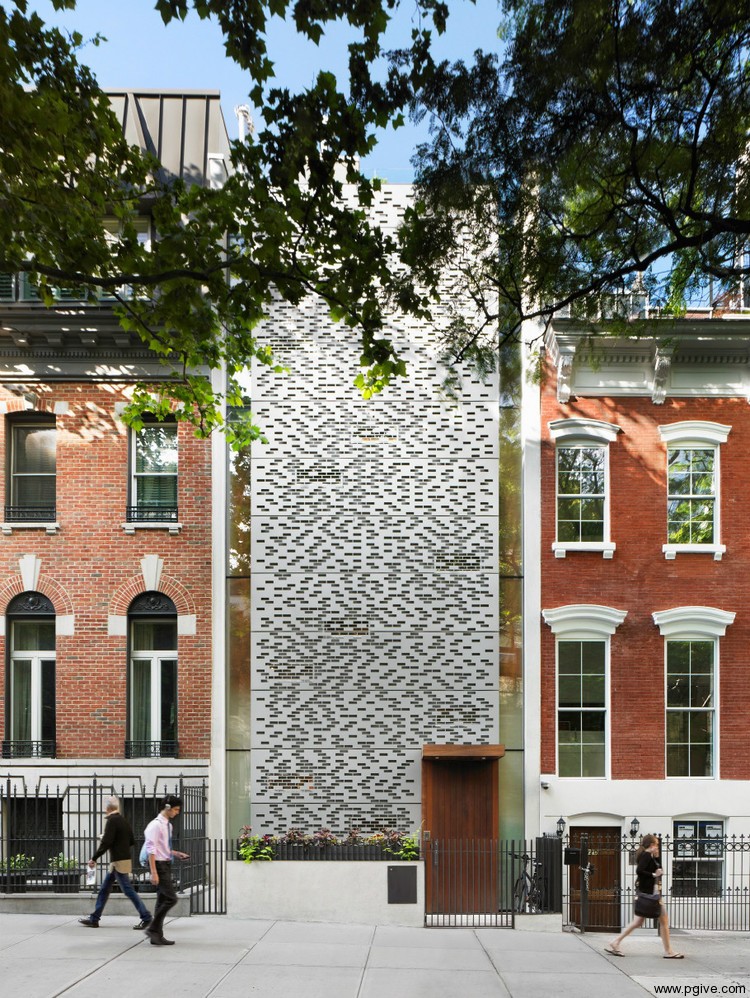
面对街道的正立面,砖形开口的铝塑板和相邻的楼层形成强烈的对比。且有效的保证了隐私和采光。
后立面则是前面的对位法:采用大量的玻璃-全高度,全幅幕墙,感受到光的沐浴。夜间,温暖的灯如的室内光照后花园。联排别墅的公共空间(客厅,饭厅,厨房)是联系在一起的一个明亮的阁楼俯瞰后院。蚀刻玻璃的上三层楼隐私的卧室和浴室,以及一个漫射光,其实比透明玻璃,明亮的。延长材料(砖,石和木材)的底楼开放式的客厅和用餐区到花园,空间体验的网站抓住了70英尺的深度。
By radically reconfiguring the organization and fa?ade of the building, open
loft-like living spaces find privacy from the street behind a four-storey
vertical library. The clients asked for generous light-filled interiors and
privacy from the street – in contrast to the standard New York City row house
with parlor room windows right on the street, usually curtained or shuttered
from the eyes of passersby.
The conventional plan and section were redefined
with the stair and elevator core pushed up against the street fa?ade, instead of
running along one of the party walls. As a result, loft-like spaces run fluidly
the entire length of the 38-foot-deep building, rather than being
compartmentalized into small front and back rooms. An open mezzanine living
room, a private office nook, and sitting rooms to private bedrooms, extend off
the stairs which wind like a ribbon around the elevator core.
The front
fa?ade engages the street with a custom water-cut aluminum rain screen with
brick-shaped openings relating to the solid bricks of its neighbors and panel
joints corresponding to the neighboring building stories. During the day, it
appears as a flat, patterned mass, marked off from the adjacent houses by the
tall glass slots on either side. The horizontal joints of the aluminum panels
break up the vertical surface as a reference to the rhythm of the window spacing
of the row houses.
At dusk, this impression wanes as the glow from the
horizontal slit windows and the vertical glass slots animates the street fa?ade.
The aluminum appears more as a screen than a mass, and invites the eye toward,
but not into, the house.
loft-like living spaces find privacy from the street behind a four-storey
vertical library. The clients asked for generous light-filled interiors and
privacy from the street – in contrast to the standard New York City row house
with parlor room windows right on the street, usually curtained or shuttered
from the eyes of passersby.
The conventional plan and section were redefined
with the stair and elevator core pushed up against the street fa?ade, instead of
running along one of the party walls. As a result, loft-like spaces run fluidly
the entire length of the 38-foot-deep building, rather than being
compartmentalized into small front and back rooms. An open mezzanine living
room, a private office nook, and sitting rooms to private bedrooms, extend off
the stairs which wind like a ribbon around the elevator core.
The front
fa?ade engages the street with a custom water-cut aluminum rain screen with
brick-shaped openings relating to the solid bricks of its neighbors and panel
joints corresponding to the neighboring building stories. During the day, it
appears as a flat, patterned mass, marked off from the adjacent houses by the
tall glass slots on either side. The horizontal joints of the aluminum panels
break up the vertical surface as a reference to the rhythm of the window spacing
of the row houses.
At dusk, this impression wanes as the glow from the
horizontal slit windows and the vertical glass slots animates the street fa?ade.
The aluminum appears more as a screen than a mass, and invites the eye toward,
but not into, the house.
图包下载
页:
[1]