|
1357| 0
|
[综合] Massachusetts General Hospital——Lunder大厦 |
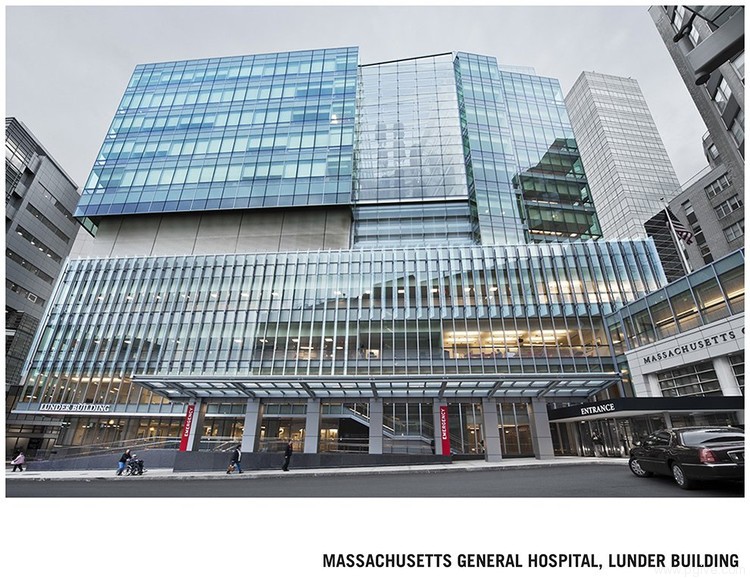
“ I see things on the Lunder patient units that I could only have dreamed of at other places I’ve worked. Private rooms, comforting colors, more light, floor to ceiling glass. It’s fun to see something new that embodies a lot of the concepts we’re looking for. ” 物业:MGH Lunder大厦,波士顿,麻省 业主:合作伙伴医疗保健 建筑师:NBBJ 建筑规模:530,000平方英尺/14层 近年来医院的设计,模拟酒店的风格视乎是一种趋势,这是让人令人生畏冷的制度类型建筑。以证据为基础的设计,源于科学研究表明患者得到更好更快的设置与日光,观点,植物,和物理和声学隐私,推动了这场革命(记录,八月2009,73页)。如果医院占重要份额通常有助于自然景色,树木,植被,水。但是,一些医院,如马萨诸塞州总医院(MGH)在波士顿,创造了一个机构在现有校园环境,密集的市中心。 NBBJ纽约办事处根据麻省总医院上述原则的基础上产生楔入集聚Lunder楼,一个新医院14层结构。150床,535,000平方英尺的设施,有28个程序和手术室,在癌症,神经内科,神经外科,放射肿瘤学,急救护理需要提供服务。 NBBJ的合作伙伴说:“以证据为基础的设计计算纳入规划,”琼·萨巴“的整体思路是,以提高运营效率以及愈合。” 在紧张的42000平方英尺的场地,建筑玻璃和钢框架插入方形多边形量对到达法院西侧,麻省总医院的主要入口。 成立于1811,马萨诸塞州总医院(MGH)是美国和在新英格兰历史最悠久、规模最大的医院第三个最古老的医院。服务近1400000门诊和放电每年超过48000名患者,医院不得不扩大服务来满足不断增长的人口和不断提供病人护理质量享誉世界,这是众所周知的。医院决定建立一个新的除了在波士顿市中心的非常紧凑的校园提供高科技,以病人为中心的医疗环境,能满足其当前需求和成长与社会的需要为下一个100年。 紧张的城市的网站和程序规定在密集的建筑项目的设计和交付的精度高的水平。建筑信息模型允许设计团队来管理安装在紧凑的网站的14层楼的复杂性;使多个连接到现有的建筑物;和环节众多部门,同时最大化的机会,为未来的灵活性,日光,病人的安全,和员工的工作效率。 连接 位于在MGH校园的心脏,它是至关重要的,Lunder大楼,方便教学,研究和病人护理的整合,使现有建筑物之间的连接。 ,NBBJ使用循环建模为便于设施的使用,病人在校园其他地方,运输服务以及物流发展的理想连接。由于缩窄现有建筑物内的地板,地板天花板高度,作出决定,限制连接到五层,其中最关键的行人交通和后勤连接现有建筑物。 自然元素 其中一个绿色设计的最明显的方面是大量的自然光充满病人的房间和公共领域。“我们将尽可能让更多的自然光进入建筑内,也尽可能多的绿化”。巨大的玻璃墙围成一个中庭,这是充满了自我浇水垂吊植物。病人的房间也有大的落地窗,俯瞰历史笔架山和查尔斯河。在屋顶和第六层可以到病房以及从相邻的MGH约基门诊护理中心。“大自然的连接是平静已经有许多研究表明,自然光是愈合的自然良药。“,有案例研究表明,阳光有助于降低工作疲劳,他们是在自然光下不是一个封闭的盒子里。 再生材料 该建筑使用再生材料,在新的设计,以获得LEED点。百分之九十四的拆迁和建筑垃圾送到垃圾填埋场回收或改变用途。 节能节水 为了节约能源,玻璃幕墙设有一个玻璃系统,最大限度地减少热量的收益和损失,同时让日光进入。该系统提高了39%的散热性能,并降低了31%,太阳能热增益。变风量空调系统,高效率的冷水机组和电动发动机,热回收系统,节约能源成为可能。超过600万千瓦时,保守估计减少12%的能源消耗。减少用水量超过20%(或1.4万加仑每年)通过安装低流量的装置,如厕所。 “我们不能安装低流量水龙头到处是由于感染控制标准”,为了消除饮用水植物灌溉使用,安装了雨水和空调冷凝水收集系统灌溉花园的植物。 健康的室内空气装饰和陈设在整个建筑很低或无挥发性有机化合物(VOCs)。一个增强的通风系统有助于确保持续供应清洁,健康的空气和气味,无毒的环境。原文: NBBJ's New York office based its design for MGH's Lunder Building on those aforementioned principles to produce a 14-story structure wedged into an agglomeration of buildings that all but hides the pillared portico of Charles Bulfinch's original neoclassical hospital of 1818. The new 150-bed, 535,000-square-foot facility, with 28 procedure and operating rooms, needed to provide services in cancer, neurology, neurosurgery, radiation oncology, and emergency care. “While evidence-based design figured into the planning,” says NBBJ partner Joan Saba, “the whole idea was to enhance operational efficiency as well as healing.” On the tight 42,000-square-foot site, the architects inserted a glass and steel-framed squarish polygonal volume on the west side of the arrivals court to MGH's main entrance. To mitigate its hulking presence, NBBJ fragmented the massing and angled exterior planes, in addition to detailing the glass facade, to express the building's separate functions on the exterior. While clear glass sheathes the first two floors (devoted to reception, emergency admissions, and circulation), vertical fritted glass fins on the third and fourth floors (dedicated to procedural services) allow daylight to enter the interior while affording occupants a sense of privacy. Above, on the fifth level, a solid wall of insulated metal panels, covered in wire mesh, masks a double-height mechanical space. For the patient-room portion, from the sixth to 10th floors, the architects emphasized the horizontal lines of glass curtain walls, which are broken by receding and slanted planes that follow the carved-out portions of the floor plate. The building inflects horizontally to MGH's Yawkey Center for Outpatient Care to the south and to the vertical glass tower of the Ellison Building to the north as part of the architects' intention to seamlessly connect Lunder visually and physically to other hospital structures around it. Connection is a major subtext: Visitors enter the new facility from the White Building, the hospital's main entrance to the north. As you come into Lunder, you find that a large stair, parallel to the glass facade, takes you to the second level, where a corridor snakes along the glass front of the building to connect Yawkey on one end with White and Ellison on the other. By placing the main circulation on the second floor, the architects linked Lunder physically to adjoining buildings, while staying within existing floor-to-ceiling heights. In the five-story bed tower, two wedge-shaped openings cut out of the overall volume accommodate an 80-foot-high skylit atrium, as well as an open-air garden court, where bamboo trees shoot upward past the patient levels. (For more details on planting for health care at Lunder, see related story.) All rooms are single-occupancy in order to prevent the spread of infection, afford privacy and acoustical isolation for recuperation, plus accommodate the patient's family members and visitors. To give the inpatient rooms views of the outdoors yet enable nurses and doctors to reach patients quickly, NBBJ placed the rooms around the edges of the broken perimeter, and located support staff in two blocks in the center. A diagonal corridor cuts through from one corner—where the elevators stop at the atrium—to the exterior garden well opposite. By breaking the nursing pods apart and connecting the floor with a diagonal circulation spine, NBBJ also mitigated excessive noise generated by movement and conversation in hospital halls and stations. Acoustical ceiling and wall panels and rubber floors also help alleviate unwanted sounds. And since rooms project into the corridors at an angle, their serrated configuration helps cut down on acoustic reverberation. This feature, along with ample cove lighting from reveals along the ceiling soffits, also softens the ambience visually. Owing to typical 9-foot ceiling heights, ample windows, and views of the city, the patient rooms seem light and airy. Translucent sliding glass doors promote visual and physical access, and for extra safety, caregiver stations inside the rooms overlook patient beds and private bathrooms. Certain treatment areas in Lunder, however, do lack daylight—specifically the radiation-oncology center in the below-grade third and fourth levels of the concrete substructure. To alleviate the sense of being so far underground, the architects designed two waiting rooms as 23-foot-high volumes; one, for reception, is illuminated by rodlike lighting fixtures suspended above the seating. Soft colors and bamboo wall panels add a residential feeling to the space. In addition, the client and NBBJ undertook sustainable measures to meet LEED Gold certification standards. These include selecting recycled or locally obtained materials plus renewable bamboo finishes, conserving water by installing low-flow plumbing fixtures, and feeding plants with nonpotable water, rainwater, and air-cooling condensate. The architects used energy-efficient insulated glass with low-E coating throughout. For patient floors they chose glazing with a high visible-light transmittance and a high shading coefficient. In addition, NBBJ selected low-iron insulated glazing for the atrium, adding fritted glass to cut glare and heat and reduce visibility in private consultation areas. All told, the Lunder Building seems to solve a lot of problems with ease. Although the hospital is not yet monitoring the effects of these design strategies on recovery time, the overall planning would suggest a promising bill of health, architecturally speaking. The scheme, at the least, offers health-care specialists an important laboratory in which to conduct and refine their research as befitting the 200-year-old institution.图包下载
购买主题
本主题需向作者支付 15 元RMB 才能浏览
| |
 关注公众号
关注公众号相关侵权、举报、投诉及建议等,请发 E-mail:pgive@qq.com
Powered by Discuz!
X5.0
© 2001-2026 Discuz! Team.|蜀ICP备12029808号| 川公网安备51010702000609号



 发表于 2013-4-10 00:37:22