简介:由Massimiliano and Dorian Fuksas(马西米亚诺和多利安·福克萨斯)建筑事务所与SPEECH(演说)建筑事务所合作建造的莫斯科理工博物馆和教育中心,其设计获得国际设计竞赛一等奖。
由Massimiliano and Dorian Fuksas(马西米亚诺和多利安·福克萨斯)建筑事务所与SPEECH(演说)建筑事务所合作建造的莫斯科理工博物馆和教育中心,其设计获得国际设计竞赛一等奖。
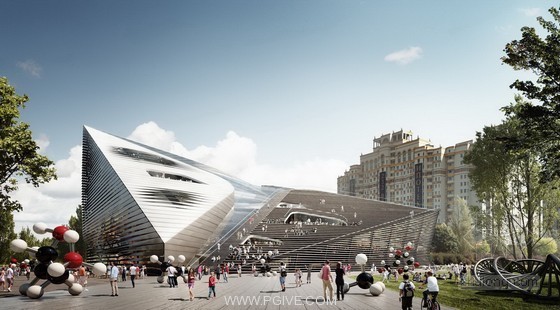
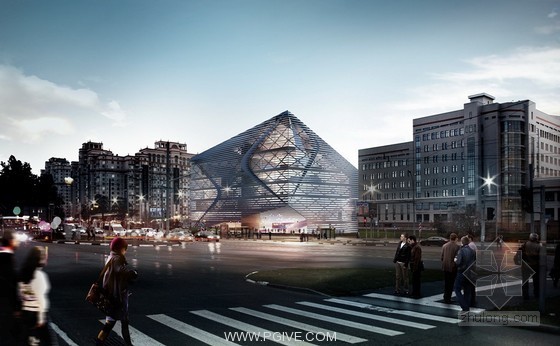
该建筑位于莫斯科麻雀山上,其所在区域附近便分布着几座具有社会主义阶级性意义的建筑。全新的博物馆由几个不规则的块状体量组成,它们的形状是被自然风力侵蚀而成。为了与周围的历史建筑相融合,建筑立面采用了锈蚀铜板。
The new Museum & Educational Center (MEC), designed by 3XN, is about connecting with people, while opening up the world of science, technology, innovation and Russia’s extraordinary achievements in these domains. Through both an internal and external architectural expression of flexibility, this proposal, which was a finalist in the international competition, recognizes that architecture shapes behavior.As technology develops, the convergence of Science and Art becomes even more relevant in our everyday interactions. In order to understand the full potential of technology, and its applications in making our world a better place.The new MEC will be a gateway to this world, challenging and evolving visitors’perception of science and technology.In contrast to traditional Museum and Learning culture which constantly advises against ‘No touching’, ‘No talking’, and rule upon rule of what is and isn’t allowed; this building is designed to say – ‘Please interact!’ – ‘Please learn!’ –and most importantly, ‘Please enjoy!’ It is an invitation to the world to enter into a common dialogue with science and technology. It is a building that encourages interaction within and around both its interior and exterior; from both the urban and architectural scale.
The MEC is placed on the outer, University ring road, yet maintains a strong relationship with the existing, formal axis and semi-circle urban planning strategy. The building is lifted for entry, grandeur and in a respectful gesture towards the main MSU building and Masterplan. The western corner pushes down to capture student activities at a more human scale, while also acting as a terminus for the outer University ring road.The external form responds to the internal concept and spiraling movement around the social and learning hub while also reacting to its surrounding context.The urban strategy is designed to be both approachable and interactive. The north-east facade responds to the grandeur and dynamism of both Lomonosovsky Avenue and the MSU tower with its ascending corner and proposed Media Facade. The south-west facade, both roof and vertical surface gradually descend and extend out towards the landscape, providing an activity space and amphitheater responding to a more human scale. Roof Café Terraces and seating are distributed around the building creating a visual and approachable building, ensuring interaction between the building and its surroundings.
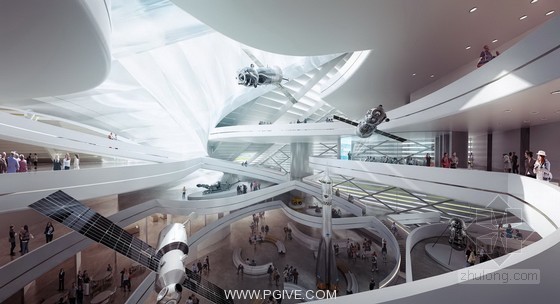
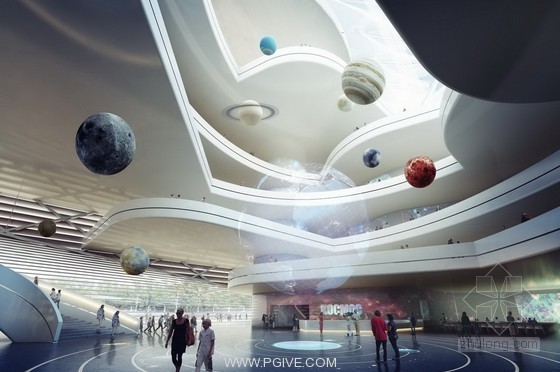
The architectural concept starts from the inside out. It begins with the desire to create a social hub – a central space – encouraging both visual and physical interaction between visitors, users and exhibitions. This is achieved through a large, diagonally oriented atrium space which spirals upwards linking the various programmatic functions and visitor experience.Shifting from the corner entry to the top-center of the roof, the atrium creates a light filled interior which penetrates deep into the building. The diagonal atrium provides deeper floor-plates at the lower levels for controlled, exhibition lighting, while creating thinner floor widths at the upper levels for non-exhibition spaces; optimizing day lighting. The ETFE roof has the capability to provide sun shading through an inflatable inner layer.
Functionally the building is quite simple.The ground floor is a microcosm of the entire MEC, containing reception areas, flexible spaces, workshops, collections storage; and a large auditorium and café which can operate independently after hours to function as a cinema. Oriented around the main atrium at levels 1 and 2 are large, simply shaped gallery spaces along the front and back facades. These climatically controlled gallery spaces are designed for flexibility and can easily allow their exhibitions to extend into the double and triple height spaces around the atrium. All back of house functions, offices, and collections storage areas are efficiently stacked between the gallery spaces and back of house elevators on the southeast edge of the building. This Back of House strategy allows staff and regular users access to these functions without the need to move through the open, visitor zones. Climatically, the MEC is zoned according to climatic needs. That is, the galleries and research spaces have a high level of climatic and environmental control systems while the public atrium spaces and offices utilize a more passively controlled system helping to balance the energy needs and make the building more sustainable.